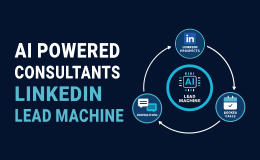
AI Powered Consultants LinkedIn Lead Machine
Build a complete AI-powered LinkedIn client acquisition system that consistently generates qualified leads and books high-value consultancy calls.

Instructor
David Tainsh
Course details
Lectures
:
18
Level
:
Beginner
- Description
- Curriculum
- FAQ
- Reviews
PART 1 — Foundations, ICP & Targeting System
-
2
 1.1 — Ideal Client Profile (ICP) for LinkedIn
You define the exact people worth pursuing: the roles that hold budget, the pain beneath what they’d say out loud, and the triggers
that turn a someday problem into a now problem. You bring the market knowledge; AI structures it into a sharp profile and flags who
to disqualify so you never spend weeks on prospects who were never going to buy. You leave with a commercial target precise
enough to point every search, message and campaign at.
-
3
1.2 — LinkedIn Profile as a Conversion Asset
The moment someone considers replying, they check your profile — and a CV-style profile loses them there. You rebuild it as a sales
page: a headline that names the outcome instead of the job title, a banner that reinforces it, an About section that opens with their
problem rather than your career, and proof placed where it reduces the risk of replying. You supply the results and the story; AI drafts
the options and then audits the whole thing against your ideal client.
-
4
1.3 — Lead Targeting & Data System (Clay Setup)
This is where strategy becomes execution. You convert your client profile into concrete targeting rules and search strings, then
structure a lead table that sources, enriches and segments prospects so every lead arrives carrying the context you need to write
something relevant. You decide who counts as a fit; AI builds the search logic, the table structure, the enrichment plan and the rules
that stop a good system quietly filling with bad data. You leave with a repeatable lead engine rather than a scraped spreadsheet.
-
5
1.4 — Walkthrough — Building the Lead Engine
You watch the full lead-sourcing process on screen: finding prospects, enriching them, and structuring the table so it feeds outreach
directly. Follow along and you finish with a working lead table you have built yourself. Any comparable enrichment tool follows the
same logic — the structure is what matters, not the brand.
-
6
1.5 — Lead Generation With Clay.com
How to use Clay.com to generate hundreds of high quality leads.
PART 2 — Messaging, Sequences & Conversion System
-
7
2.1 — Connection Messages That Get Accepted
Not to sell, not to explain — to earn permission to keep talking. You learn why most requests get ignored, which is almost always that
they’re about the sender, and what changes it: brevity, one specific relevant detail, and curiosity instead of a pitch. AI generates the
variations across four opener types and groups them by audience; you judge which ones sound like a human wrote them.
-
8
2.2 — Follow-Up Sequences That Generate Replies
Most replies don’t come from the first message — they come from the third or fourth, which is why so many people conclude
LinkedIn doesn’t work when what actually happened is they stopped too early. You build a five-message sequence that keeps you
present without becoming a nuisance: value first, then a real question, then proof, then a soft pitch, then the ask — spaced so it
reads as a person who’s genuinely interested rather than software working through a list.
-
9
2.3 — Converting Conversations Into Strategy Calls
Most people lose the deal by pitching in messages. You replace that with a structure: engage, understand, qualify, transition. That
means questions that surface pain and urgency without feeling like an interrogation, a simple qualification test so you stop giving
your best hours to people who’ll never buy, calm answers to the four objections you’ll actually hear, and a call ask that reads as the
obvious next step rather than a close. This is where automation stops and you take over.
-
10
2.4 — Walkthrough — Building the Messaging System
You watch the full messaging system being built out on Claude.
PART 3 — Automation, AI & Scaling System
-
11
3.1 — Personalisation at Scale
Manual personalisation doesn’t scale; automation without personalisation doesn’t convert. You build the engine that does both —
enriched data in, a reusable prompt framework in the middle, a genuinely specific message out, per lead. You set the tone and the
quality bar; AI maps data points to messaging angles, generates the variations and then checks its own output against your
standard. You learn to tell a message that references someone’s real situation from one that just merges their first name.
-
12
3.2 — Outreach Automation System
Automation handles the volume; you handle the conversations. You build campaigns that connect, follow up and sequence
automatically — with daily limits, profile warm-up, natural delays and message rotation designed in from the start rather than bolted
on after a restriction. You set the thresholds; AI structures the campaigns, the timing, the safety rules and the per-audience setup.
You leave knowing exactly what your safe daily ceiling is and what a campaign should look like before you ever press start.
-
13
3.3 — Tracking, Optimisation & Scaling
Scaling a broken system just breaks it faster. You track the four numbers that matter — acceptance, reply, conversation and booking
rate — and learn to read them diagnostically: low acceptance is a targeting or first-message problem, low replies is a messaging
problem, low calls is a conversion problem. AI builds the benchmarks, the diagnostics, the testing structure and the scaling
thresholds; you make the calls. You also set your stop conditions before you need them, which is the difference between a dip and a
lost account.
-
14
3.4 — Walkthrough — Outreach Automation (Dripify)
Importing your leads, building the campaign sequence, configuring the delays, and running it inside safe daily limits — demonstrated
in full so you can build the same campaign alongside it.
-
15
3.5 — Walkthrough — Outreach Automation (Meet Alfred)
The same campaign built in a second platform, so you can choose the one that suits how you work. Everything in this course runs on
either — the safety limits, delay logic, rotation and reply detection work the same way on both, so your configuration transfers unchanged.
-
16
3.6 — Walkthrough — Automation and Scaling
Walkthrough of the AI prompts used in this section.
PART 4 — System Deployment
-
17
4.1 — Assemble The Machine
Complete step by step walkthrough on how to deploy the complete system.
-
18
4.2 — Master Prompt & System Control Panel
Two tools that keep the system alive after the build. The first is a single master prompt that reads your knowledge base and every
asset you’ve built and produces the entire system in one execution. Use it to build fast if you’d rather not run the packs individually,
and to rebuild whenever your offer, niche or market shifts — it’s what stops the system going stale six months from now. The second
is your control panel: forty short, single-job prompts that display, verify and pressure-test any part of what you’ve built, without
regenerating anything.
Can I use this if I am just starting out?
Yes. The course is aimed at consultants who are starting out as well as those systematising something that already works. You need a consulting, advisory or done-for-you service to sell, and you bring the expertise and point of view.
Do I need a big LinkedIn network already?
No. The system builds its own list from scratch: you define who is worth messaging, then source and enrich them. A small, well-described list outperforms a large vague one at every stage.
Will this get my LinkedIn account restricted?
Not if you follow the limits in it. Account safety is built into the automation lessons, with conservative daily volumes, a warm-up period, message rotation, natural pacing and written stop conditions.
Does AI have the conversation for me?
No. Automation covers the connection request and the follow-up sequence and stops the moment somebody replies. Every message after that is written by you.
Do I need paid tools?
You can complete the course without them. Sales Navigator and an enrichment tool save time and are demonstrated, but the lead engine lesson includes a free-search path so nothing is blocked behind a subscription.
Which tools are shown in the walkthroughs?
There are on-screen walkthroughs of building the lead engine, lead generation with Clay.com, and outreach automation in Dripify and in Meet Alfred. The safety limits, delays, rotation and reply detection work the same way in either automation tool.
Is this just templates?
No. Every message is generated from your own knowledge base, built in the pre-course lesson, so it references your buyer, your problem and your proof.
What exactly do I get?
There are 18 lessons: a pre-course knowledge-base lesson, then four parts covering targeting, messaging, automation and system deployment. It also includes the prompt packs and SOPs, follow-along sheets for the software walkthroughs, a master prompt that rebuilds the system and forty single-job control-panel prompts.
How long does it take?
The lessons are short, but this is a system you build rather than a video you watch. You work through it in a few sittings, then run a weekly routine of about twenty minutes to keep it sharp.
How much does it cost, and is there a guarantee?
$28 as a single payment, with lifetime access including updates. There is a 30-day money-back guarantee, with no questions asked and no criteria to meet.
Please, login to leave a review