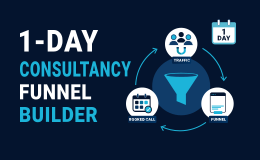
The 1-Day Consultancy Funnel Builder
Build a complete consultancy client acquisition funnel in one day—from social media ads to webinar to strategy call—so you can ...
Show more

Instructor
David Tainsh
Course details
Lectures
:
17
Level
:
Beginner
- Description
- Curriculum
- FAQ
- Reviews
Pre Course Set Up
-
1
 0.0 Build Your Knowledge Base
Before you build anything, you load your business into a knowledge base — who you serve, the problem you solve, your offer and your
voice — using the setup files provided. Every asset you create today reads from it, so your ads, page, webinar and call script come out
consistent and on-brand from the first draft, not as generic AI output.
-
2
0.1 Knowledge Base Set Up Live
Here I will log into Claude and show you live step by step how to set up your knowledge base. This is a very important step and one the rest of the course builds from.
-
3
0.2 The 1 Day Consultancy Funnel Strategy
Complete strategy walk through so that you are familiar with the process before we proceed to the main course. This will enable you to know where each asset goes as we build it.
PART 1 — Audience & Ad Engine
-
4
1.1 Lock ICP & Commercial Targeting
You define the exact clients worth advertising to: the decision-makers, the pain they'll pay to remove, and the triggers that make them
buy now. You bring the market knowledge; AI structures it into a sharp Ideal Client Profile and flags who to disqualify so you never burn
budget on the wrong people. You leave with a commercial target precise enough to point every ad, page and call at.
-
5
1.2 Ad Messaging Architecture
You write ads that stop the right person mid-scroll, using a proven structure that names their result, removes their main objection, and mirrors their current frustration. AI drafts the variations from your profile and voice; you pick the ones that ring true. You walk away wita set of ad messages ready to run — not a blank ad account and a vague idea.
-
6
1.3 Campaign Targeting Logic
You turn your profile into concrete audience segments, targeting filters and exclusions, so your budget only reaches the decision makerwho can actually hire you. AI maps the segments and structure; you approve the logic. You leave knowing exactly who each ad is aimed at — and who it's set to avoid.
-
7
1.4 Live Workshop — Audience & Ad Engine
You watch every prompt from Part 1 run live, in order, on a real consultancy — the profile, the pain stack, the triggers, the exclusions, the advert template and the targeting. Nothing is pre-baked or edited around: you see the raw outputs, the ones that come back weak, and exactly how they get corrected.
PART 2 — Conversion Assets
-
8
2.1 Landing Page Architecture
You build the webinar registration page that turns a click into a signed-up lead — problem framed, you positioned as the guide, and a single clear call to register. AI drafts the structure and copy from your knowledge base; you keep it honest and on-brand. You walk away with a finished landing page built to convert, not a blank template.
-
9
2.2 Hero Webinar System
You create your webinar using the Hero Story framework — the prospect is the hero, you're the guide, and there's a clear plan to solve their problem. AI builds the slide-by-slide outline and script from your knowledge base; you bring the story and the proof. You leave with a webinar that teaches genuine value and makes the case for working with you, without feeling like a pitch.
-
10
2.3 Webinar → Strategy Call System
You build the close: the call-to-action, the booking flow, and the follow-up emails that move a webinar viewer onto your calendar. AI drafts the CTA script and the reminder sequence; you set the offer and the standard. You walk away with the mechanism that converts attention into qualified strategy calls.
-
11
2.4 Live Workshop — Conversion Assets
You watch the full set of Part 2 prompts run end to end — landing page structure and copy, the Hero Story outline, the slide flow, the CTA script and the follow-up emails. You see how each one inherits from the work done in Part 1, and where the output needs your judgement rather than another prompt.
PART 3 — Closing & Deal Control
-
12
3.1 Diagnostic Sales Framework
You replace the improvised sales call with a structure that surfaces the real problem, quantifies its cost, and positions your consultancy as the logical next step. AI generates the diagnostic questions and qualification logic from your knowledge base; you run the conversation. You leave with a repeatable call framework that qualifies hard and closes cleanly, without pressure.
-
13
3.2 Objection Handling Matrix
You prepare confident, non-defensive responses to the objections that stall deals — price, timing, risk and trust — before they ever come up on a call. AI drafts the matrix from your offer and buyer; you make it sound like you. You walk away never again caught flatfooted by a predictable objection.
-
14
3.3 Proposal & Follow-Up Control
You build the proposal and the follow-up system that carries a warm conversation to a signed deal — structured, outcome-led, and paced so prospects don't go cold. AI drafts the proposal and the follow-up sequence; you keep the final say. You leave with a closing process that protects momentum and lifts your conversion.
-
15
3.4 Live Workshop — Closing & Deal Control
You watch the Part 3 prompts run in sequence — diagnostic questions, qualification logic, the objection matrix across price, timing, trust and risk, then the proposal and follow-up system. Because these outputs decide what you say in front of a buyer, the workshop spends as much time correcting the drafts as generating them.
PART 4 — System Deployment & Automation
-
16
4.1 The Master Consultancy Engine
You run a single master prompt that checks your knowledge base and every asset you've built, stops if anything's missing, then generates the full funnel in one execution — webinar script and slides, landing page, LinkedIn, Facebook and YouTube ads, retargeting, call script, proposal and follow-up emails. You bring the finished inputs; the engine assembles the system.
-
17
4.2 Modular AI Deployment Prompts
You get a set of reusable, single-job prompts — build one ad set, one landing page, one call script, one proposal, an objection response for a specific deal — so you can rebuild or extend any part of the funnel whenever you need it. AI does the production; you direct it. You leave with an operational toolkit that keeps working long after day one.
Can I really build the funnel in a day?
Yes, if you arrive with your knowledge base filled in, which is what the pre-course classes are for. The build itself is four parts of about an hour each, and each part uses what the last one produced.
What will I have at the end?
A complete client-acquisition funnel in your own words: advert messages and targeting, registration page copy, a seven-step webinar and slide flow, a booking flow with follow-up emails, a diagnostic call framework, an objection matrix and a proposal with follow-up. You also get a master prompt that regenerates the whole funnel.
I'm just starting out with no clients. Is this for me?
Yes. The course is built to take you from your first client to a full diary. If you have no client results yet, the funnel is built from the expertise you already have, such as your career, projects and what you know about your buyers, and you add proof as it comes in.
How is the course structured?
There are 17 lessons: three pre-course classes on your knowledge base and the funnel strategy, then four parts covering audience and ads, conversion assets, closing and deal control, and system deployment. Parts 1 to 3 each end with a workshop lesson where every prompt in that part is run end to end on a real consultancy.
Do I need an ad budget?
You can build and finish everything without spending anything. When you go live, the course recommends one segment on a small budget rather than several audiences at once, so you can read the results.
Do I need an audience already?
No. You define who is worth advertising to, and the targeting reaches them.
Does AI run the sales call?
No. Automation covers everything up to the booking, including adverts, page, registration, reminders and follow-up, while the diagnosis and the relationship stay with you.
What if I already have a webinar or a landing page?
Bring them. The lessons show you what is missing rather than making you start again.
Which AI does it use?
Primarily Claude, with your business captured in a knowledge base every prompt reads from. The prompts work with other assistants too.
How much does it cost, and is there a guarantee?
$28 as a single payment, with lifetime access including updates. There is a 30-day money-back guarantee, with no questions asked and no criteria to meet.
Please, login to leave a review